MenoPause
Real-time gesture interaction, design and evaluate an immersive entertainment mechanism
- Role
- Tools
- Credits
"If people talked more about it, it would decrease anxiety. Even a small ritual could create a calm atmosphere." — Interview participant
Highlights
Research that changed the brief: We went in expecting to hear about symptoms. Across five interviews, we heard about silence — the real unmet need was not information, but a space to speak and to know others shared the experience.
From experience to form: Every design decision traces back to research — a daily light signal to break the silence, anonymous voice sharing for connection on the user's own terms, and a physical ritual instead of another app.
A tension worth naming: Evaluation revealed that the same feature made some users feel connected and others feel intruded upon. Instead of hiding it, we framed it as the central open question of the project.
Judgment over compliance: We changed what blocked users, deliberately kept what protected the experience, and documented what we couldn't build — and why it matters most.
Background
Menopause affects roughly half the world's population, yet it remains largely unspoken. In our interviews, one participant only connected her symptoms to menopause after researching it herself online — her doctor never mentioned it. Others kept their discomfort private so as not to worry their families, or worried about sweating in front of customers at work.
Existing technology for menopause mostly focuses on symptom tracking and medical information. Very little addresses the emotional and social side of the transition.
Within a course brief on rituals — intentional, symbolic actions that help people mark life transitions — we asked: what if the silence itself was the design problem?
How might we design a simple daily ritual that restores calm, confidence, and connection for people going through menopause?
Research
Literature review (11 papers). We reviewed HCI and social research on menopause, bodily transitions, digital health, and ritual. Papers were individually coded and synthesized on a shared Miro board into four themes: experiences, design approaches, rituals, and reframing perception.
Semi-structured interviews (n=5). Four people currently going through or past menopause, plus one expert who was also experiencing it. A pilot interview helped us refine the guide for flow and sensitivity before the main sessions.
What we heard. Experiences varied widely — from an "unexpected storm" to a transition that passed almost unnoticed. But one pattern held across almost every conversation:
"Almost no one talks about it. Everyone just goes through it quietly."
When participants did find others who understood — colleagues of the same age, a supportive partner — the relief was immediate. This shifted our direction: the problem wasn't a lack of information. It was a lack of space — somewhere private enough to feel safe, and connected enough to feel less alone.
Persona. We synthesized the findings into Katrin, 52 — an economist in Stockholm who first suspected pregnancy, figured out what was happening herself online, and keeps her disrupted sleep and hot flashes to herself.
Research → Design
Three findings became three design decisions:
Silence → a visible daily signal. Participants had no natural moment to bring menopause up. The lamp lights up once a day on its own — a cue that family members can learn to recognize. The ritual itself becomes the communication.
Exposure → connection on her terms. Participants wanted to feel less alone, but didn't want their vulnerability on display. You speak to the lamp, not to a person. Recordings are stored anonymously, and sharing is always the user's choice.
Data fatigue → embodied, not informational. Users weren't lacking data about their bodies — they were lacking a moment of calm. An app would add another screen. A lamp adds light, scent, and a reason to stop.
The Artifact
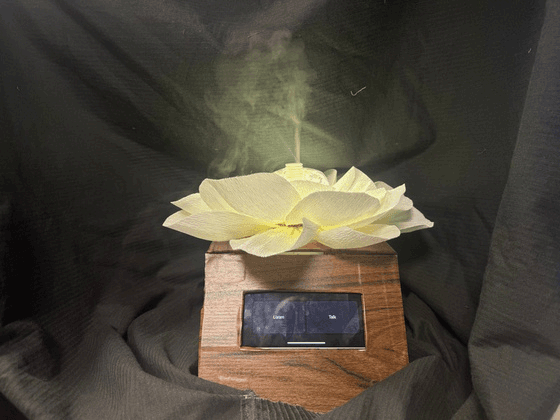
The ritual. Once a day, the lamp blooms with soft light and releases a gentle scent. The user walks over and begins the ritual: in Talk mode, they speak freely and choose whether to share their recording anonymously. In Listen mode, they hear a voice someone else left behind.
My main contribution was the product design — deciding what the lamp should feel like, and therefore what it should look like.
Natural materials. Not feminine, not minimal. We explored a stereotypically feminine style and a minimalist one. Feminine design risked reinforcing the stigma around menopause and adding shame to using the object; minimalism read as technological, cold, and clinical. Paper and wood textures felt warm and alive without being gendered — something that belongs in a home without announcing why it's there.
A flower opening, not one falling. A common metaphor frames menopause as a flower wilting. Inspired by literature we read during research, the lamp's form inverts this into a second bloom — not an ending, but an opening.
Both hands, not a tap or a voice. A single tap on a screen felt too casual for the experience. Voice activation would require always-on listening, raising GDPR and consent concerns and making users feel watched in a moment meant to be private. Placing both hands on the lamp asks you to stop and be present — the gesture is where the ritual begins.
Development
- Lo-fi prototype & first evaluation: A physical lamp paired with a simple web app simulating Talk and Listen. We compared two versions — a breathing light while talking vs. a light colour users chose themselves. Participants described the ritual as "cozy" and "mood-lifting", wanted visible feedback that the lamp was listening, and gave mixed reactions to hearing strangers' recordings.
- Hi-fi prototype, round 1: The plan was a 3D-printed shell, Arduino-driven LED strips, copper-wire touch fabric, and a scent diffuser. LEDs failed, touch sensors lacked sensitivity, and 3D printing was too slow for our timeline.
- Hi-fi prototype, round 2: We asked what the prototype actually needed to test — would people speak to a lamp? — and rebuilt with what was available: a cardboard shell with wood-pattern finish, fairy lights, and a smartphone running a web app as the touch interface. The scent diffuser stayed: scent was never decoration, it was part of the ritual.
Evaluation
We evaluated in two layers, so that real users' time would go to the questions only they could answer.
Before users — Cognitive Walkthrough. We stepped through the interaction ourselves as first-time users, alongside a guideline review of the visual style. This surfaced ambiguous icons and missing confirmation after uploading a recording.
With users — Cooperative Evaluation. Participants explored the lamp while thinking aloud, guided by a short task scenario: "Imagine the lamp has just lit up for the day. Please use it as you naturally would." They confirmed both issues from the walkthrough — and found one we hadn't: the light didn't respond to their voice, so talking felt one-directional.
Key findings
What we changed. Testers expected the buttons their phones had already taught them. The microphone became a record dot, headphones became a play triangle, and the upload arrow became the word "upload". In a follow-up round, no one mentioned the icons again.
What we deliberately kept. One tester was unsure whether an interaction had finished, because the screen didn't return home automatically. We chose not to add an auto-reset: being "done" with an emotional moment isn't the same for everyone, and snapping back would impose a pace the lamp has no business imposing.
The central tension. The Listen feature — our direct answer to isolation — split participants. For some, hearing another person's voice was comforting. For others, it broke the private, reflective mood the lamp had just created. The same feature that made some users feel connected made others feel invaded.
Our hypothesis: sequence. We suspect the difference lies in order. A stranger's voice may feel like intrusion when it arrives before you've spoken, and like solidarity once you've given something of yourself first. This is still an assumption — and the first thing we would test next.
Reflection
Meno-Pause taught me that research is only valuable if you can trace it into decisions — and that the most useful finding of a project can be the one that complicates your concept. If we continued, I would start with the smallest study that could settle the biggest question: testing whether speaking before listening changes how anonymous voices are received. Beyond that, the lamp needs to listen back — voice-responsive light is what separates a ritual object from an appliance. And our participants were mostly articulate people who had already made sense of their experience; the people who might need this most — those still in the confusion of early symptoms — weren't in the room yet.