Does an Empty Street Still Talk?
A VR study on how street-level attributes and greenery shape women's sense of safety in urban environments.
- Role
- Tools
- Credits
- Research
- VR
- UX Research
- Urban Design
The question
Public space has a well-documented gender safety gap — women consistently report feeling less safe than men in environments urban planners consider "neutral." We wanted to know: what specifically makes a street feel safe, even when no other people are actually present?
We focused on perceived liveliness — visual cues suggesting human presence, like parked bikes, storefronts, and greenery — and tested how it shapes women's sense of safety using an immersive VR street scene.
Method
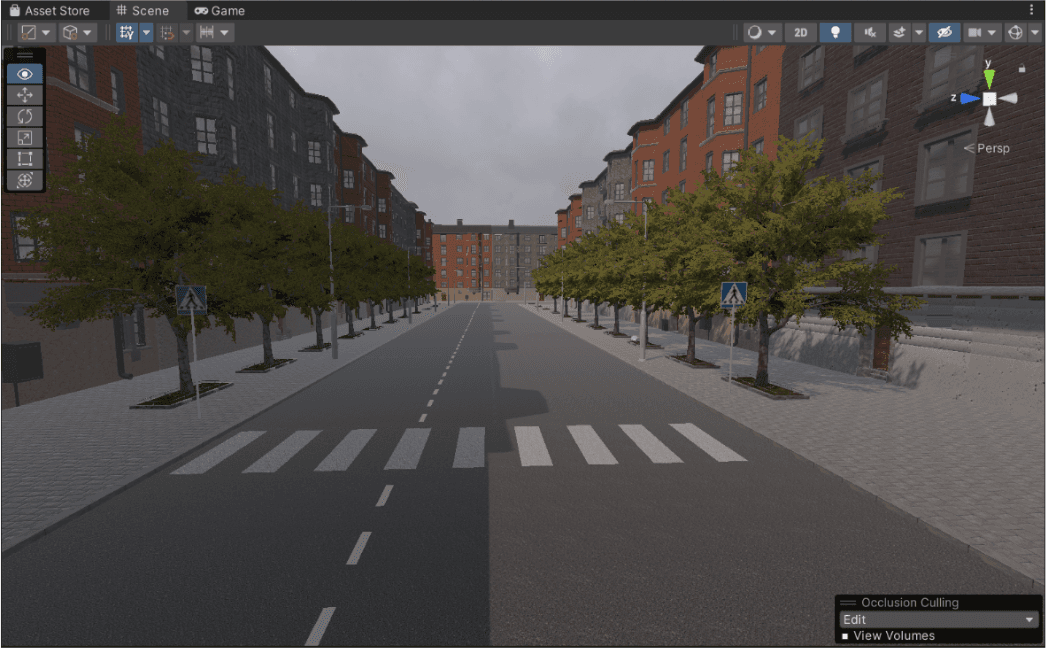
Fifteen women (21–32) explored a Unity-built urban street corner through a Meta Quest 2 headset. We varied two things: street-level attributes (cars, bikes, a storefront, a bus stop — present or absent) and greenery density (none, low, high), creating six possible street conditions.
Each participant made 15 paired comparisons using a two-alternative forced-choice (2AFC) task — shown two streets side by side, they picked whichever felt safer within 12 seconds, going with their gut. Afterward, we ran semi-structured interviews and three questionnaires covering perceived safety, sense of presence, and simulator sickness.
Key findings
Streets with more attributes were consistently chosen as safer than empty ones — 93% of participants said any sign of activity (a bus stop, a bike, a lit storefront) made a street feel more used, and therefore safer.
The more surprising result: greenery didn't behave the way we hypothesized. Low-density greenery was preferred over high-density greenery, though not by a statistically significant margin. Interviews explained why — dense trees blocked sightlines and created places where someone could be hiding, invoking exactly the tension the Prospect-Refuge theory predicts between wanting cover and wanting visibility.
The resulting hierarchy of perceived safety, from safest to least safe:
- Street-level attributes + high-density greenery
- Street-level attributes + low-density greenery
- Street-level attributes alone
- Low-density greenery alone
- High-density greenery alone
- Empty street
Street-level attributes mattered more than greenery on their own — visibility and signs of human activity outweighed vegetation quantity.
Reflection
VR turned out to be a genuinely good tool for this kind of research — it let us precisely control variables (greenery density, specific objects) that would be nearly impossible to manipulate in a real street. Participants reported feeling reasonably present in the simulation and minimal motion sickness, which gave us confidence the results would transfer to real-world intuition.
The main constraints were sample size (N=15, all KTH students) and some Unity scene quirks — car orientation and object placement weren't perfectly controllable between the paired streets, which is a confound worth addressing in a follow-up study with virtual pedestrians and ambient sound.